
No products in the cart.

Preventing the Summer Slide for Neurodiverse Learners
Summer can be a welcome break from school routines, homework, and the daily rush to get out the door. For neurodiverse children, however, the change in structure can be challenging. Without regular practice, students may lose academic stamina and forget learned skills, resulting in feeling anxious when school begins again in the fall.
When students forget what they learned the previous year is often called the summer slide. For students with ADHD, dyslexia, dysgraphia, executive functioning challenges, or other learning differences, the summer slide may show up in ways that go well beyond reading and math. The good news: preventing the summer slide does not mean recreating school at home. In fact, don’t! Learning works best when it is consistent, low-pressure, and connected to real life. In this article, we’ll dive into relatively low-effort and simple ways to keep learning through the summer months.
Keep a Gentle Routine
Children benefit from predictability. Summer can throw routines out of whack, but this will work against what works for your child. Routine is about providing a child with a sense of what to expect. It doesn’t need to be rigid. A simple daily routine listed on a whiteboard or pinned to a corkboard is enough. Checklists and whiteboards help students who struggle with transitions or working memory. The goal is to reduce the number of decisions your child has to make every day by letting them know what to expect. A simple routine will be your friend.
Build Into Real Life
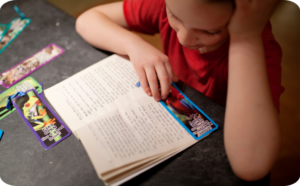
Reading practice is one of the most powerful ways to prevent summer learning loss, but you don’t want it to look like a formal assignment. Let your child read anything they can. This includes graphic novels, audiobooks, recipes, menus, sports articles, travel guides, or instructions for a favorite game. It can be a joint effort in which they read part of a recipe while you read the rest. Measure progress in willingness and not in pages. While driving, play an audiobook to build vocabulary, comprehension, and background knowledge, all while driving to your destination. Let your child pick the audiobook. Discuss what it’s about in advance. Some stories require background knowledge that adults have, but children haven’t learned. If you are listening to the Percy Jackson series, talk about Greek mythology. The story is going to make much more sense if you understand who the Greek gods are. Otherwise, Zeus, Poseidon, Hades, the concept of a demigod, the Underworld, and a quest. These are all topics most adults are familiar with but may not be understood by a 12-year-old. If you start by asking questions, you’ll quickly ascertain your child’s level of understanding and how much background knowledge they will need to appreciate the richness of the book. Writing can also be lost over the summer. A fun way to incorporate writing is to send letters and cards to relatives via snail mail. Plan out what to write ahead of time, and let them write the card and address the envelope. You would be surprised by how many children do not know where the return address is written on an envelope.
Practice Math in Small Ways
Math skills can fade quickly when they are not used. Don’t think in terms of worksheets during the summer. Instead, look for everyday math moments. Bake cookies and have your child double the recipe. They won’t even realize that they are practicing. When grocery shopping, have them calculate the cost of two brands that come in different sizes. Estimate the cost of a family outing to the movies before you go. For younger children, count the steps between getting out of the car and entering the house. Math is everywhere; you just have to give voice to it. For students with dyscalculia or math anxiety, short practice is often more effective than long review sessions. Keep it brief and connected to something concrete. Play dominoes and talk through the steps. Giving voice to your thoughts helps them understand the actions. The more they can see and touch the activity, the better they understand the concept.
Support Executive Functioning Skills
Summer is a great time to practice executive functioning because the stakes are lower. Students can work on planning, organizing, time management, and task initiation without the pressure of school. Try giving your child ownership of one manageable project. This might be planning a family movie night, packing for a day trip, organizing art supplies, or helping prepare a meal. Before the
task, ask:
What materials do you need?
What should happen first?
How long do you think it will take?
What might get in the way?
These questions help children think through the process instead of jumping straight into action or avoidance. Act as the assistant and write it down if they are reluctant to write. This is about executive functioning skills, and you can work on writing at a different time. After they finish, compare the time it actually took to plan everything with what they estimated it would take.
Have a discussion about any difference between the estimated time and the actual time. Ask the question why? You are looking for them to verbalize their thought process so that you can identify ways to strengthen that skill.
Protect Downtime
Neurodiverse students often work harder than their peers during the school year. Summer needs to include downtime so they can recharge. Unstructured time, outdoor play, creativity, and boredom all have value. That said, some children need help knowing what to do with open-ended time. Create a “when I’m bored” list with options such as drawing, building, biking, listening to music, puzzles, reading, crafts, or calling a friend. This gives your child independence without leaving them overwhelmed by too many choices. Learning how to manage boredom is an important life skill that needs to be learned.
Preview the Return to School
In the final weeks of summer, gradually shift wake-up times, revisit school-year routines, organize supplies, and talk through what the new year may look like. For anxious students, previewing is powerful. Review the new schedule and look at photos of teachers from the yearbook. If they will be attending a new school, is there an opportunity to visit the school before the first day? For middle school students, many schools have a locker day in which students come to the school to practice opening their lockers.
You can even make a “What I wonder” list at the beginning of the summer. This is a list of items that they are anxious about. Don’t go through all the items when they make the list. Bring them up over the summer, when your child is relaxed. Having your child verbalize the unknown provides an opportunity to discuss each item, but you want to talk when they are open and relaxed.
When Extra Support Helps
If your child ended the school year frustrated, behind, or losing confidence, summer can be an ideal time for targeted support. Educational therapy, academic support, reading intervention, or executive functioning coaching can help students strengthen skills without the pace and pressure of the school year. During the school year, neurodiverse children are often exhausted at the end of the day. Intervention during the summer builds a bridge to a new school year. Contact Us to discuss your child’s needs so that we can structure support that works for your family.
Written by Tracy Young, SFL Clinician, CALT, MBA





No comment yet, add your voice below!